GenAI: My Take
October 12, 2025
I didn’t start reading the news when I was very young. I remember beginning the habit in high school. My house was quite far from school, and I had to take the school bus every day. Since I lived closest to the bus driver, I was usually picked up first (around 5:30 AM, if I remember correctly) and dropped off last.
I had a lot of time to kill.
Most of the time, I’d use the time to resume my much needed sleep. But on some days, I’d get very bored and I started to pick up this habit. After much exploration on the news apps that were available at that time, CNN stuck to me.
I dug up my Google Photos from the year 2013 and found these screenshots:
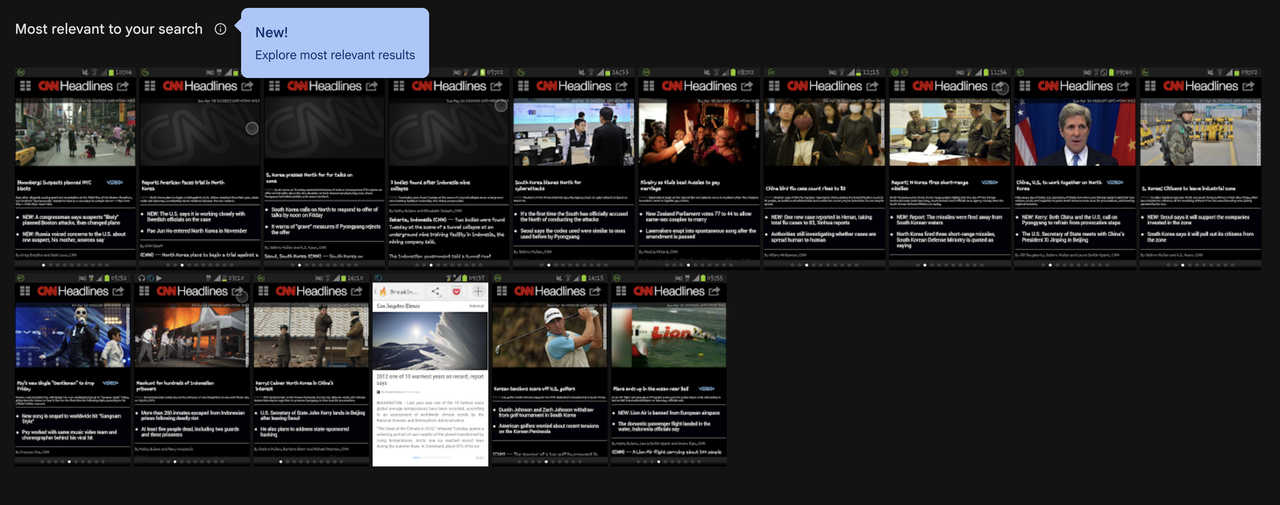

Why did I take those screenshots, you might ask. I think I remember thinking, “If one day something truly big happens, like World War III, I’d have excerpts of all the events leading up to it.” Maybe I wanted to use them as a kind of badge of honor, to say, “Look! I knew it’d happen!”
As a side effect of all those news catch-ups, I was exposed to daily updates about what was happening around the world. I’d keep up with the latest developments in tech, new gadgets, and upcoming projects. Since I was already interested in the tech scene, I eventually subscribed to the “Tech” topic on Google News as well.
Not long after starting this news-reading-on-the-bus-ride habit, I wrote a blog post predicting what might happen by 2025.
Unfortunately, I don’t have a backup of that post, nor do I remember all of it. But I do recall two of my tech-related predictions:
-
I predicted that by 2025, Google’s Project Ara would take off and change how people bought and used smartphones. (That one didn’t come true, the project was shut down in 2016.)
-
Around that time, Yahoo was making a lot of acquisitions, including Tumblr in 2013. I predicted that by 2025, Yahoo would stop acquiring companies and would eventually be acquired itself. (That one did come true when Verizon bought Yahoo’s core internet business in 2017.)
What I definitely didn’t remember predicting was — you guessed it — the rapid development of generative artificial intelligence, or as we now affectionately call it, GenAI.
At that time, what I imagined as AI were robots and science fiction. The narrative that it could eventually control and destroy humanity was, to me, just barely a narrative. It was three years before I majored in CS, and I was quite far from the academic side of it. I, along with many others, didn’t see this coming.
Today, I use GenAI literally every day, and my life has been quite different because of it.
The company I work with is pretty ahead and very persistent in getting employees to use GenAI in our everyday work. We’re subscribed to almost every AI engineering and enterprise tool you’ve probably heard of. We also organize frequent hackathons that require us to vibe-design and vibe-code. Teams that manage to one-shot (or nearly one-shot) their quarterly projects, and complete them within just a few days using only AI are recognized and celebrated.
In our interview process for junior and mid-level engineers, we encourage (read: enforce) candidates to use tools like ChatGPT, Cursor, or Windsurf to solve problems. I can’t really share in detail what my experience as an interviewer has been, but I can tell you it’s been absolutely fascinating.
Outside of work, GenAI has become my default go-to search engine. I rarely go through Google’s search results page to find answers to my questions anymore. I hardly ever scroll past the AI Overview section. Once I get my answer at the top of the page, I just move on.
I know a lot of people have even shifted completely to ChatGPT to find answers to all of life’s questions. My husband relies on it all the time now.
I remember when we were both preparing for our first half marathon back in April this year, we still relied on YouTube videos and reading through running blogs to learn how to properly carb-load. But when he was preparing for his second half marathon last Sunday, I found him exclusively chatting with ChatGPT. It does everything for him. It recommended the amount of calories he needed to take and created a personalized meal plan. We actually ended up buying groceries based on what ChatGPT recommended.
The model behind GenAI and the software that support its use cases have improved immensely in just a matter of months. The rate of change and improvement is unprecedented (as Trump likes to label things). It’s not like cryptocurrency, where early pessimists can afford to stay pessimistic for years. If you were doubtful about what GenAI could do last year and still are today, you’re probably not following things closely enough.
A few weeks ago, I sat down for a casual lunch with some fellow people in tech. Among them was someone I consider the smartest person I know from university. He shared his experience of feeding ChatGPT a competitive programming problem he had written.
“It gave a working solution within two tries. And what’s crazier was, its solution was better than mine!”
That moment reasserted what I had been feeling for quite some time. This technology is surpassing most people’s problem-solving skills and cognitive abilities, and it’s doing so very, very fast. I’m not too familiar with how this improvement feels in day-to-day life outside of software engineering, but I’d imagine it’s not all that different.
I’m not going to tell you what you should do to catch up or how to use AI to give yourself an edge. Nor will I share concerns or make predictions about the future of jobs because of this development. There’s already plenty of content out there that does that.
What I’d like to share in this post is one major concern of mine that I believe will be accelerated by the rapid development of GenAI: the decline in literacy and reading comprehension among people of all ages.
In 2024, the average reading (and math) scores of American high school students fell to their lowest levels in two decades. A recent research also discovered that reading for fun in the US has fallen by 40%.
Of course, what’s happening in the U.S. doesn’t necessarily represent what’s happening, or will happen in the rest of the world. But to me, it gives a general idea of the impact of technology and policies being implemented there, many of which are also being adopted by other countries.
Gone are the days when students needed to craft smart keywords for search engines, skim through Wikipedia or academic papers, and piece together the citations they needed for their research projects.
Gone are the days when computer science majors had to browse Stack Overflow, read through error messages and issue descriptions, and figure out whether they related to the problem they were facing.
Gone are the days of sifting through pages of text or handwritten blog posts to find that one golden piece of information you needed.
Now, all it takes is a simple sentence of exactly what you want to happen: a prompt to ChatGPT or Gemini. You toggle on Deep Research, and boom, you get exactly the answer, the excerpts, and the citations you need.
What’s being reduced here is our time to read. We used to have to read through things to find and to understand. That requirement has now become almost obsolete. We are also reducing our need to think. Pure optimists might argue that by delegating some of these lower-level thinking tasks to AI, we are freeing up more mental capacity for higher-level thinking. But spend just 15 seconds reflecting on your recent uses of AI: do you actually use the time you saved to think about more complex and meaningful ideas?
It would be counterproductive to force yourself not to use this technology when everyone else is, especially when the software has become so much better and far more efficient at handling tedious tasks than we are. Collectively, we will become more productive. There is simply no economic reason to swim against the current.
Still, I would argue that it is not nearly as productive, economically or otherwise, to lose our ability to read and think critically. This is not the same as when people stopped relying on mental math after calculators were invented. Depending on a machine to tell you what two to the power of sixteen is has a very different societal consequence than depending on a machine to answer, “What can we do to stop the atrocities happening in Gaza? Give me ten suggestions.”
So what do you suggest we should do, Irene? This post is getting a bit longer than usual 🥱
Well, if you’re wondering why I started this post by bragging about a habit I picked up as a 15-year-old, and feel like I didn’t quite manage to segue into the rest of the post smoothly enough, it’s actually a teaser for what I’m suggesting we should do more often.
Read the news. Even better, if you have access to the paper or e-paper version of a reputable and trustworthy publication, make a habit of reading it. My go-to is The Straits Times. I used to subscribe to the paper edition when I first moved to Singapore, and later switched to the e-paper when it became too expensive for me. Over time, I’ve grown familiar with the writing styles of its journalists and found that the articles are often relevant.
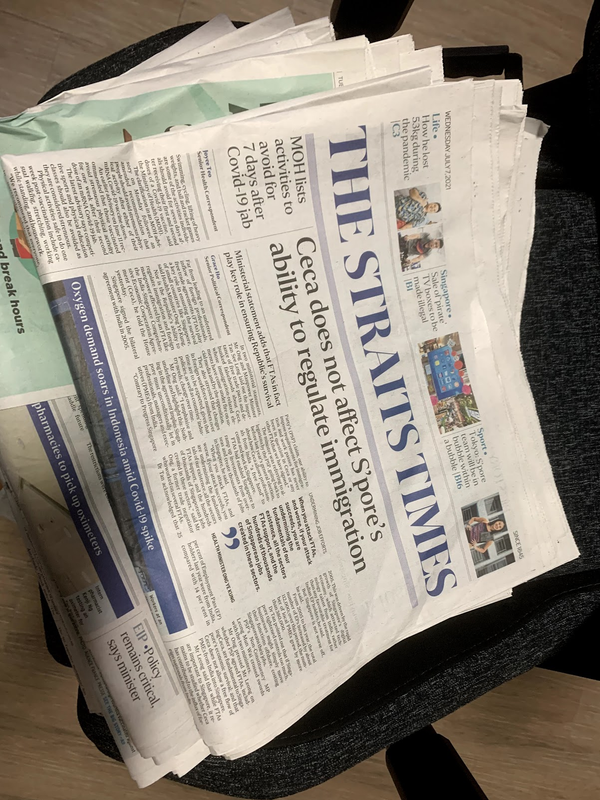
Why newspapers? Because news articles, especially those published in traditional paper form, are very rarely AI-generated. They need to contain truthful information and be concise. They are written by journalists and newsroom editors who write to put food on the table, so the quality of the writing is usually quite good. In a world full of AI-generated content, I find news articles refreshing. To this day, I avoid reading AI-generated pieces like the plague whenever I sense one.
I personally recommend the paper or e-paper version instead of the app or mobile version because it encourages you to skim through headlines rather than being fed one article after another by the algorithm. It first exposes you to a wide range of information at a glance and forces you to do a little thinking: “Hmm, what do I want to read next?”
In my experience, reading the newspaper demands real attention. One article usually takes at least three minutes to read, which I think is a very useful skill to train these days. It also exposes you to information you might not otherwise encounter if you did not follow the news. Reading the newspaper has helped me form informed opinions on global politics, economics, and influenced some of my investment decisions.
If you often find yourself overwhelmed by news shared on social media, try reading the newspaper instead. News that are posted and shared in platforms like Instagram or X are often optimized for engagement. What this means is they’d use headlines that are more catchy and might be misleading.
Many of these accounts are also in a race for engagement, which can lead to sharing information that hasn’t been properly fact-checked. I’ve seen accounts in Instagram that call themselves as “news platforms” spread incorrect information. Sometimes, there are upsides to receiving a news at 6 a.m. the next day rather than 10 minutes after something happens. There are also a lot of benefits when the news publication is economically relying on readership and subscriptions (which is usually the case with paper publications) rather than the number of likes or shares.
I think that’s all I want to share in this post. If you’ve managed to read through and reach this point, congrats! I truly commend your attention span, and of course, thank you for sticking it out with me. Hope you find this useful or at least entertaining!
Are you curious if I used AI to write this post? Well, yes. I used it to fix grammar and tidy up some sentences, but I forced myself to handwrite and think through everything I included here. Like all of my other posts on this blog, I wouldn’t publish it if I wouldn’t want to read it myself.

I create this little space on the internet to write my thoughts and reflections on being a human, a woman, and a software developer. I don't have Instagram/Twitter but I can be found on LinkedIn. Feel free to contact/give feedback/tell me your story through my email: ivanaairenee@gmail.com